NbRe: First Triplet Superconductor at 7 K
Authors: F. Colangelo, M. Modestino, F. Avitabile, A. Galluzzi, Z. Makhdoumi Kakhaki, A. Kumar, J. Linder, M. Polichetti, C. Attanasio, C. Cirillo

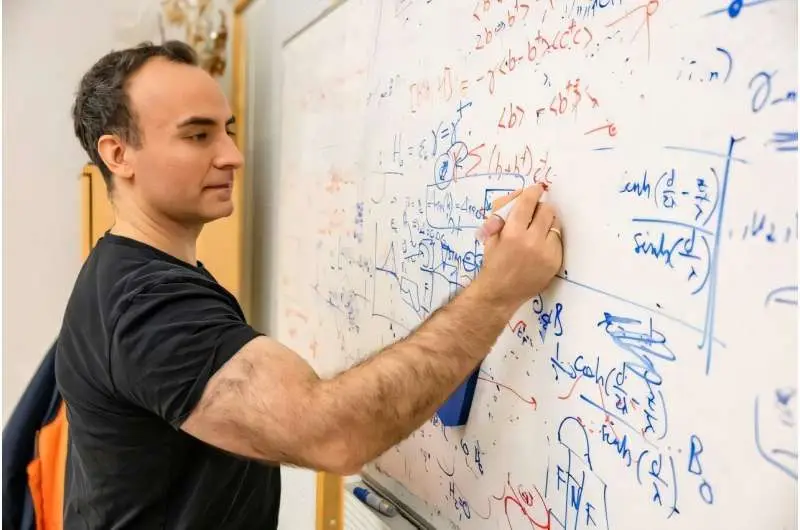
Imagine a wire that carries electric current with zero losses — and on top of that, carries information about the spin of electrons. Not just electric current, but spin current. That is precisely the state of matter that theory predicted, and that a team led by Professor Jacob Linder of the Norwegian University of Science and Technology has now detected in a niobium-rhenium alloy — at a temperature of 7 kelvin. The paper was published in Physical Review Letters with an editor’s recommendation, a signal that referees considered it exceptional.
How We Got Here: A Decades-Long Search
Ordinary superconductivity was discovered in 1911: mercury, cooled to 4 K, suddenly loses all resistance to electric current. The explanation came only in 1957, when Bardeen, Cooper, and Schrieffer showed that electrons in a superconductor pair up into so-called Cooper pairs. These pairs behave as a single quantum entity and move without scattering.
For a long time, it was assumed that Cooper pairs always form with opposite spins — one electron «up, ” the other „down.“ This is singlet pairing: the total spin of the pair is zero, and the state is antisymmetric. The theory worked beautifully, and in the vast majority of known superconductors this is exactly what happens.
But in the 1970s, theorists began to realize that the symmetry principle does not forbid another possibility. If both electrons in a pair have the same spin — both «up» or both «down» — triplet pairing emerges. Such a pair carries total spin 1, not 0. This changes everything: a triplet superconductor can carry not only electric current but also spin current without dissipation. And spin current is the language of quantum computers.
The search for triplet superconductors became its own branch of physics. The leading candidate for decades — the perovskite Sr₂RuO₄ — was studied intensively. In 1994, p-wave triplet pairing was claimed in it. But by 2019, careful Knight shift measurements dismantled the key argument. The debate continues to this day. Uranium ditelluride UTe₂ and the heavy-fermion compound UPt₃ are other hot candidates, but definitive proof remains elusive in both.
The common problem: proving triplet pairing is extraordinarily difficult. You need not just a superconductor, but a device in which the consequences of triplet pairing can actually be observed. This is precisely where the material NbRe enters the picture.
The Discovery: Spins Aligned in the Same Direction
NbRe — an alloy of niobium and rhenium — belongs to the class of noncentrosymmetric superconductors.
Noncentrosymmetric superconductor — a material whose crystal lattice lacks a center of inversion. This broken symmetry makes it possible for singlet and triplet pairing states to mix — something forbidden in ordinary (centrosymmetric) materials.
The absence of inversion symmetry in NbRe is precisely what allows singlet and triplet components to coexist in a single material — at least in theory. The question was how to prove it.
Linder’s team used an elegant approach: the inverse spin-valve effect.
Spin valve — a device consisting of two ferromagnetic layers whose electrical resistance depends on the relative orientation of the layers’ magnetizations. When the magnetizations are parallel, resistance is minimal; when antiparallel, it is maximal. An inverse spin valve is the opposite situation: resistance is higher in the parallel configuration.
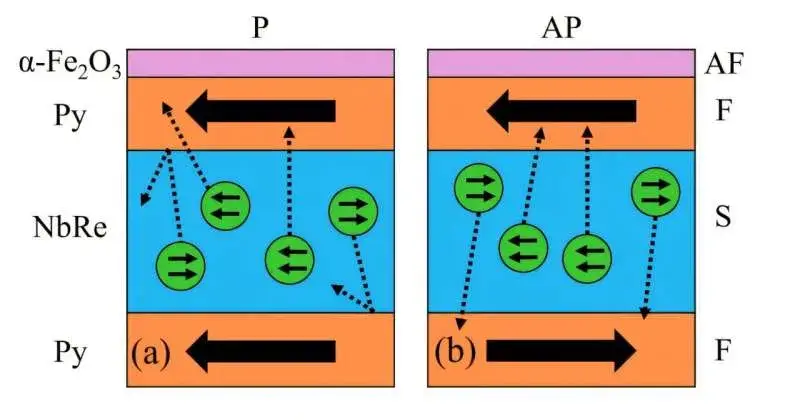
The device was assembled as a Py/NbRe/Py trilayer with an antiferromagnetic α-Fe₂O₃ capping layer. Here Py stands for permalloy, a classic ferromagnet. Two permalloy layers «sandwich» NbRe from both sides. The antiferromagnet α-Fe₂O₃ on top of one layer creates different coercive fields in each permalloy layer, allowing independent control of their magnetizations.
The physicists cooled this device below the critical temperature of NbRe (approximately 7 K) and measured the superconducting critical currents at different orientations of the ferromagnetic layers’ magnetizations.
The result: the critical current was higher in the antiparallel configuration than in the parallel one — a classic inverse spin-valve signature. This is direct experimental evidence that equal-spin triplet Cooper pairs penetrate from NbRe into the ferromagnetic layers. Ordinary singlet pairs are destroyed instantly by the exchange field of the ferromagnet; triplet pairs with equal spins are not.
How It Works: Inside the Device

The key to understanding the result lies in the nature of NbRe’s noncentrosymmetry. In an ordinary superconductor the crystal lattice is invariant under inversion: if you «mirror-reflect» the entire structure through a point, nothing changes. In NbRe this is not the case — and the broken symmetry gives rise to antisymmetric spin-orbit coupling.
Spin-orbit coupling — the interaction between an electron’s intrinsic angular momentum (spin) and its orbital motion. In noncentrosymmetric crystals it takes a special form and «mixes» states with different spin orientations.
This mixing creates a conversion mechanism: near the interfaces with the ferromagnets, the singlet order parameter is partially converted into a triplet. The nonuniform magnetization at the NbRe/Py interface acts as a «translator» between the singlet and triplet languages.
Superconducting order parameter — the quantum-mechanical quantity that describes the superconducting state. Its behavior at the boundary between two materials determines which type of Cooper pairs can propagate from the superconductor into the adjacent layer.
When both permalloy layers are magnetized in parallel, the situation at both interfaces is identical. Triplet pairs with total spin +1 and -1 are generated symmetrically and cancel each other. When the orientation is antiparallel, this cancellation is broken, and pairs with equal spin begin to dominate. They propagate freely deep into the ferromagnetic layer. This is the inverse spin-valve effect.
Critically, the transition temperature of NbRe sits at approximately 7 K — roughly seven times higher than that of Sr₂RuO₄ (~1 K). This makes NbRe substantially more practical for future devices.
Critical temperature (Tc) — the temperature below which a material enters the superconducting state. The higher the Tc, the cheaper and simpler the cooling required for practical application.
Why This Changes Everything
The connection to quantum computing is not obvious, but it is profound. Modern quantum computers suffer from a single dominant disease — decoherence: quantum information stored in a qubit is destroyed by interaction with the environment in microseconds. This is why quantum computers still operate only under conditions of extreme isolation.
Topological qubits based on Majorana particles promise a fundamentally different solution.
Majorana particles — hypothetical (and, in condensed matter physics, potentially realizable) quasiparticles that are their own antiparticles. Quantum information encoded in a pair of Majorana particles is nonlocal — it is «spread» across space — and is therefore protected from local perturbations.
Triplet superconductors, especially those with nontrivial topological band structure, are theoretically capable of hosting Majorana bound states at their boundaries. This makes NbRe a candidate for topologically protected qubits.
A separate application is spintronics. Devices that carry spin current instead of electric current consume significantly less energy. A triplet superconductor that carries spin current without dissipation is a potential building block for next-generation quantum logic elements.
More broadly, the search for materials for quantum devices is advancing on many fronts . Unlike theoretical predictions for MXenes, the present work offers a real experiment with a measurable and reproducible signal.
Critical Analysis
This analysis draws on publicly available data and the original paper text.
The strength of this work rests on several reinforcing pillars. Publication in Physical Review Letters with an editor’s recommendation is not a minor credential — it is one of the most selective venues in physics, and the recommendation signals that referees found the result not merely correct but exceptional. The experimental architecture itself is another asset: the straightforward Py/NbRe/Py trilayer is a clean, interpretable geometry that leaves little room for alternative explanations compared to more elaborate device designs. Perhaps most practically significant is the 7 K transition temperature — roughly seven times higher than that of the perennial triplet candidate Sr₂RuO₄. At that temperature, liquid helium cooling is considerably more tractable and affordable than at 1 K, which matters greatly for any future laboratory follow-up. Finally, the collaboration between Linder’s QuSpin theory group and the Italian experimental team means the results were interrogated from two independent directions before publication.
That said, the case for triplet pairing in NbRe, however compelling, remains indirect. The inverse spin-valve effect is not a direct measurement of the order parameter symmetry — it is a transport signature consistent with equal-spin triplet Cooper pairs, but consistency is not proof. This distinction matters because condensed matter physics has a specific and somewhat bruising history with triplet superconductors: claims for Sr₂RuO₄, UPt₃, and UTe₂ all generated intense excitement and all remain contested to varying degrees. The NbRe result has not yet been independently reproduced by other groups, which is the field’s gold standard for any claim of this magnitude. Manufacturing high-quality Py/NbRe/Py devices also requires precision magnetron sputtering and strict interface control — a nontrivial barrier that makes rapid independent replication harder, not easier.
The most fundamental open question is therefore simple to state and hard to answer: will other laboratories see the same inverse spin-valve signal in NbRe? Beyond that lies an even larger technological gap — between a beautiful laboratory trilayer and a working topological qubit. Even if NbRe’s triplet status is confirmed, the path from that confirmation to devices that host and manipulate Majorana particles reliably remains largely uncharted. And 7 K, however better than 1 K, still demands liquid-helium infrastructure that is far from compatible with compact practical hardware. The result is genuinely exciting; the journey ahead is long.
What Comes Next
The Norwegian QuSpin group under Linder is one of the leading theoretical centers in superconducting spintronics. In parallel, the global community is actively investigating other noncentrosymmetric superconductors: Li₂Pt₃B, BiPd, CePt₃Si. If NbRe’s triplet status is confirmed by independent groups, this will accelerate the entire field.
The group’s next steps will likely include spin transport measurements directly probing the triplet component, and a search for signatures of topological edge states — the first indirect fingerprint of Majorana particles. Experiments of this kind could transform a beautiful PRL result into the foundation for next-generation quantum technologies.
For now, this is a very promising first step — but a step in exactly the right direction.
References
Related Articles

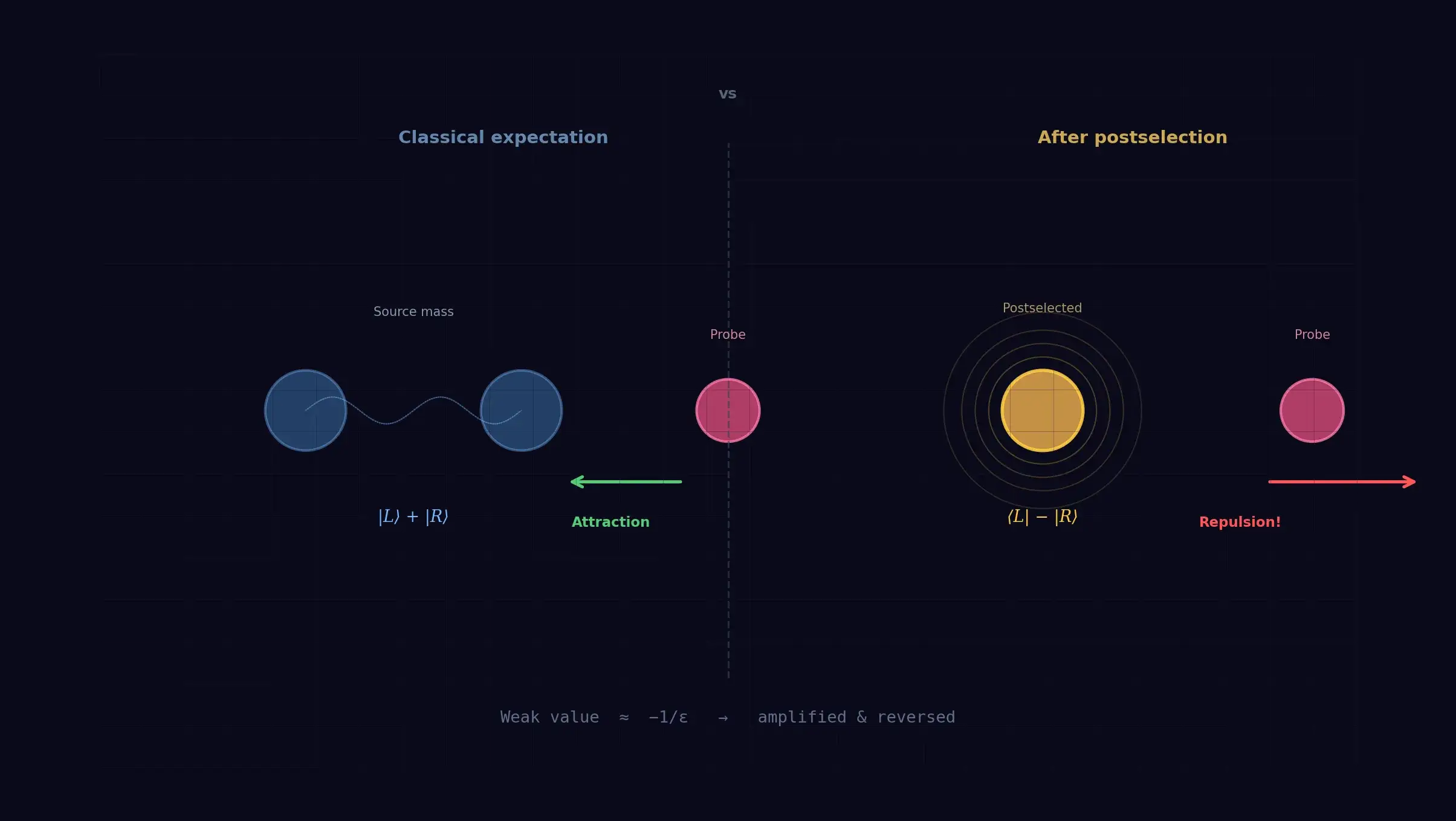
Gravity in Reverse: A Quantum Trick That Repels
Two physicists showed how quantum superposition and clever filtering make gravity push instead of pull. No new physics needed — just quantum weirdness.

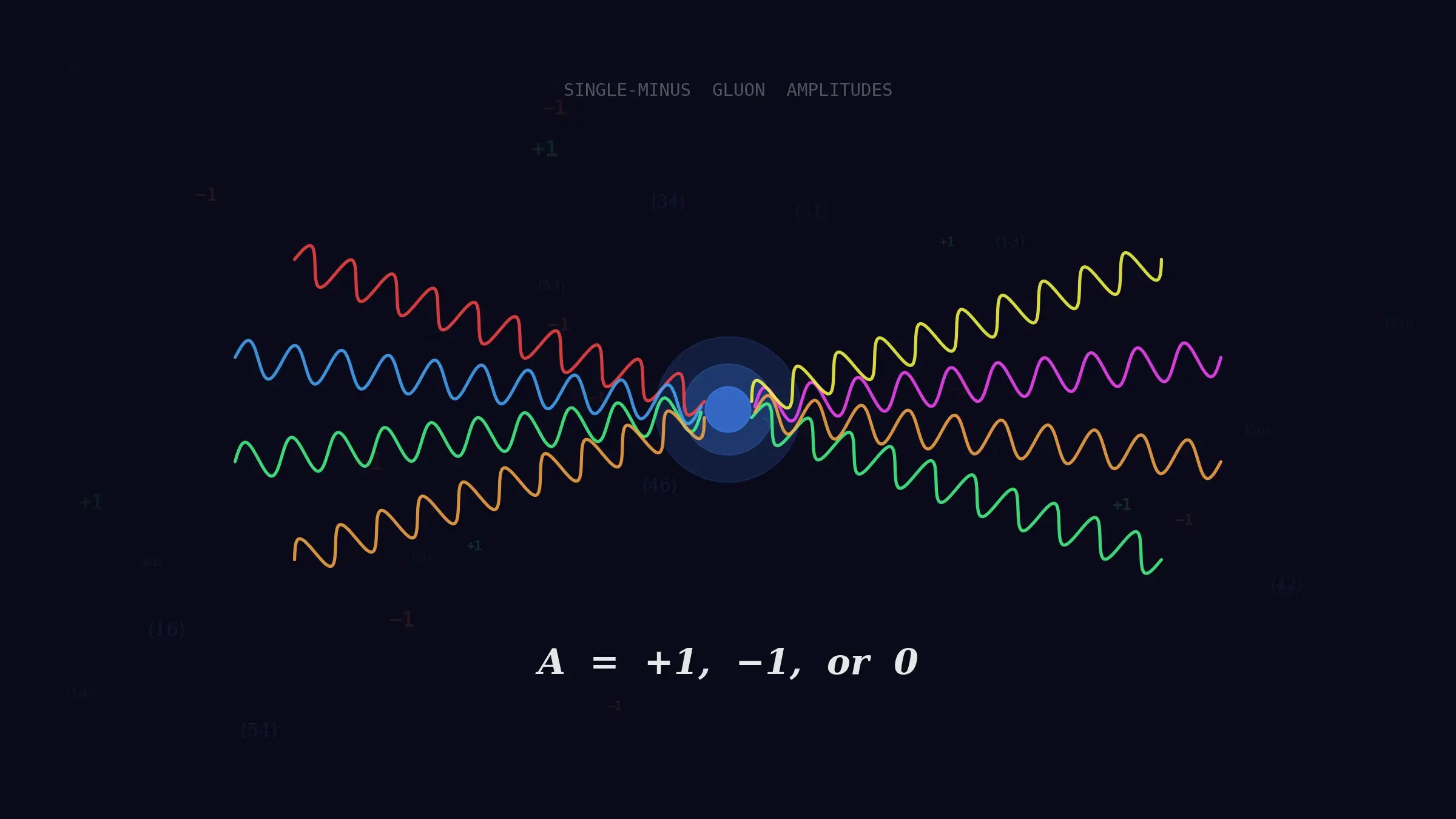
GPT-5.2 Cracked a 40-Year Gluon Mystery
OpenAI's model conjectured a formula for gluon amplitudes assumed zero since 1986. Physicists from Harvard and Cambridge confirmed it was right.

AI Finds 25 Rare-Earth-Free Magnets in 67,000
AI-curated database of 67,000 magnetic materials reveals 25 high-temperature alternatives to rare-earth magnets for EVs.