Gravity in Reverse: A Quantum Trick That Repels
Authors: Sougato Bose, Lev Vaidman

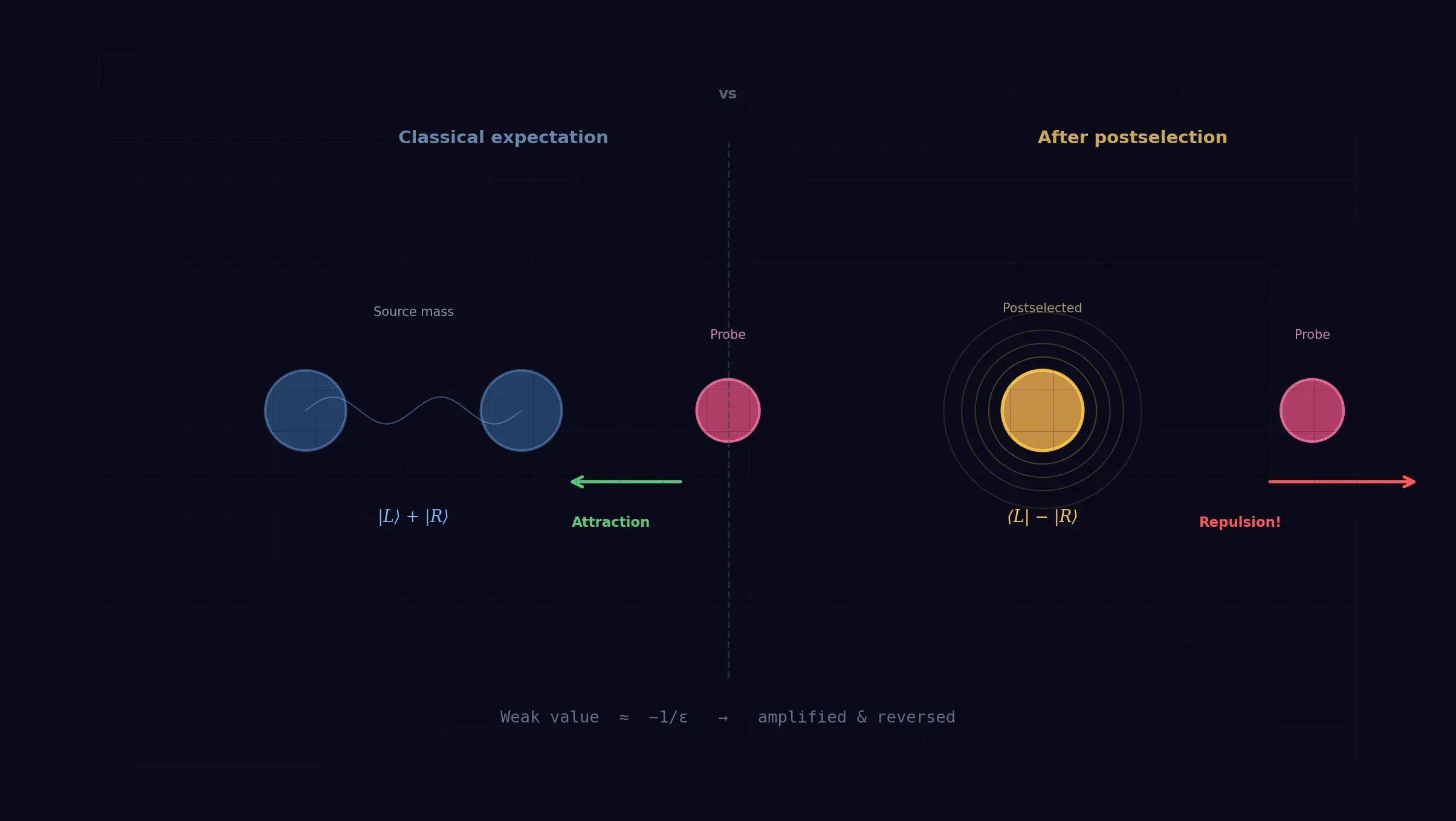
Drop a ball. It falls. Every time. Gravity pulls, never pushes. Newton wrote this into law three centuries ago. Einstein rewrote gravity as curved spacetime, but the direction stayed the same: masses attract. Period.
Except Sougato Bose at University College London and Lev Vaidman at Tel Aviv University have just described a laboratory scenario where gravity effectively repels. Their February 2026 preprint lays out a tabletop experiment with two tiny masses, quantum superposition, and a statistical trick called postselection. Under the right conditions, the probe mass drifts away from the source — as if gravity had flipped its sign.
Three Ingredients for Antigravity
The recipe requires three quantum concepts working together. First: superposition.
Quantum superposition — a state in which a particle or object exists in multiple positions simultaneously. This is not a metaphor: until measured, the object is mathematically «smeared» across two locations at once.
Picture a grain-sized mass placed in a superposition of two spots: «left» and «right.» A second mass — the probe — sits nearby, feeling the gravitational tug of the first. If the source lands on the right (closer), the probe gets pulled slightly toward it. If on the left (farther), barely any pull. So far, textbook physics.
Second ingredient: weak measurement.
Weak measurement — a way to peek at a quantum system without destroying its state. A standard measurement collapses the superposition; a weak measurement nudges the detector so gently that quantum coherence survives.
The gravitational pull between two microscopic masses is a natural weak measurement. The force is so feeble that the momentum transferred to the probe is far smaller than its quantum uncertainty. The detector barely flinches — the source’s superposition stays intact.
Third: postselection.
Postselection — keeping only those experimental runs where a final measurement yields a pre-chosen outcome. You run the experiment a million times, then discard everything except the rare cases where the source ended up in a specific state.
Here is where things get strange. Bose and Vaidman choose the interferometer’s «dark port» for postselection — a state the source almost never lands in. When you look only at those rare events, the probe’s average momentum points away from the source. Gravity appears to push.
The Dark Port Reversal
How can selecting rare outcomes flip a force? The answer lies in weak values, a concept introduced by Yakir Aharonov, David Albert, and Vaidman back in 1988.
Weak value — the average of a quantum observable computed only over postselected experimental runs. It can exceed the normal range of the observable: becoming huge, negative, or even complex.
Think of it this way. You flip a coin a hundred times. On average, 50 heads — nothing surprising. Now suppose you ran a second die alongside each flip, and you keep only those trials where the die landed on six. In that filtered subset, the average number of heads might be 70 or 30, depending on subtle correlations between coin and die.
Quantum correlations are far more exotic than anything a coin and die can produce. The weak value of the operator «source mass is on the right side» — after postselection onto the dark port — comes out to roughly −1/ε, where ε is a tiny asymmetry parameter. Negative. And enormous in magnitude.
In the filtered runs, the probe behaves as though it sat next to something with negative mass, amplified by a factor of 1/ε. The gravitational signal doesn’t just reverse — it gets stronger.
Diamonds on a Lab Bench
Bose is one of the architects of the famous BMV proposal (Bose-Marletto-Vedral, 2017) for testing gravity’s quantum nature with tabletop experiments. The new paper follows the same philosophy: no accelerators, no black holes. Just small masses, magnetic gradients, and patience.
The proposed setup uses a diamond nanocrystal hosting a nitrogen-vacancy (NV) center as the source mass. A magnetic field gradient couples the crystal’s spin to its position, creating a Stern-Gerlach interferometer. The crystal weighs about 10⁻¹⁴ kg and enters a superposition spanning ~50 micrometers. The probe — a heavier particle (~10⁻¹² kg) — is released from an optical trap roughly 20 micrometers away.
A superconducting shield sits between the two masses, blocking all electromagnetic and surface forces. Only gravity passes through.
The numbers are sobering. Postselection succeeds in about ε²/4 ≈ 2,5 × 10⁻⁵ of runs. Distinguishing the shifted state from the unshifted one works about 1% of the time. Multiply those together: one useful outcome per four million trials. A statistically significant result demands roughly 40 million runs.
Not Antigravity — Quantum Filtering
Headlines might scream «antigravity, ” but that would be wrong. No single run of the experiment shows repulsion. In every individual trial, the probe shifts toward the source — exactly as gravity demands. The «repulsion» emerges only in the statistics of the filtered subset. It is not a new force. It is not a violation of general relativity. It is a consequence of quantum interference under a very particular choice of initial and final states.
That doesn’t make the result trivial. If the experiment succeeds, it demonstrates something profound: the gravitational field itself can exist in quantum superposition. And that is direct evidence for the quantum nature of spacetime.
We already know that neutrons and atoms behave quantum mechanically in Earth’s gravitational field — interferometry experiments proved this decades ago. But in those experiments, Earth’s gravity is classical. The planet is not in a superposition. The Bose-Vaidman scheme puts the source of gravity into a quantum state — and measures the consequences.
This is a preprint that has not yet undergone peer review. The interpretation of weak values remains a subject of philosophical debate within the quantum foundations community.
Why Testing Quantum Gravity Matters
Gravity is the only one of nature’s four fundamental forces without a universally accepted quantum theory. Electromagnetism, the strong force, the weak force — all described by quantum field theory. Gravity — not yet. The core reason: no experiment has ever demonstrated that gravity requires a quantum description.
The Bose-Vaidman proposal is one attempt to build that experiment. If the probe mass shifts away from the source after postselection, classical gravity cannot explain it. A classical field does not produce negative weak values. Only quantum superposition of spacetime itself generates that signature.
Realization is far off. Maintaining coherent superpositions of masses for seconds, achieving angstrom-level position sensitivity, suppressing every parasitic force — each is a formidable engineering challenge. But reframing the question — testing quantum gravity on a lab bench instead of at Planck energies — already changes what physicists think is possible.
References
Related Articles

NbRe: First Triplet Superconductor at 7 K
Physicists found triplet Cooper pairs in niobium-rhenium at 7 K — opening a path to fault-tolerant topological quantum computers.

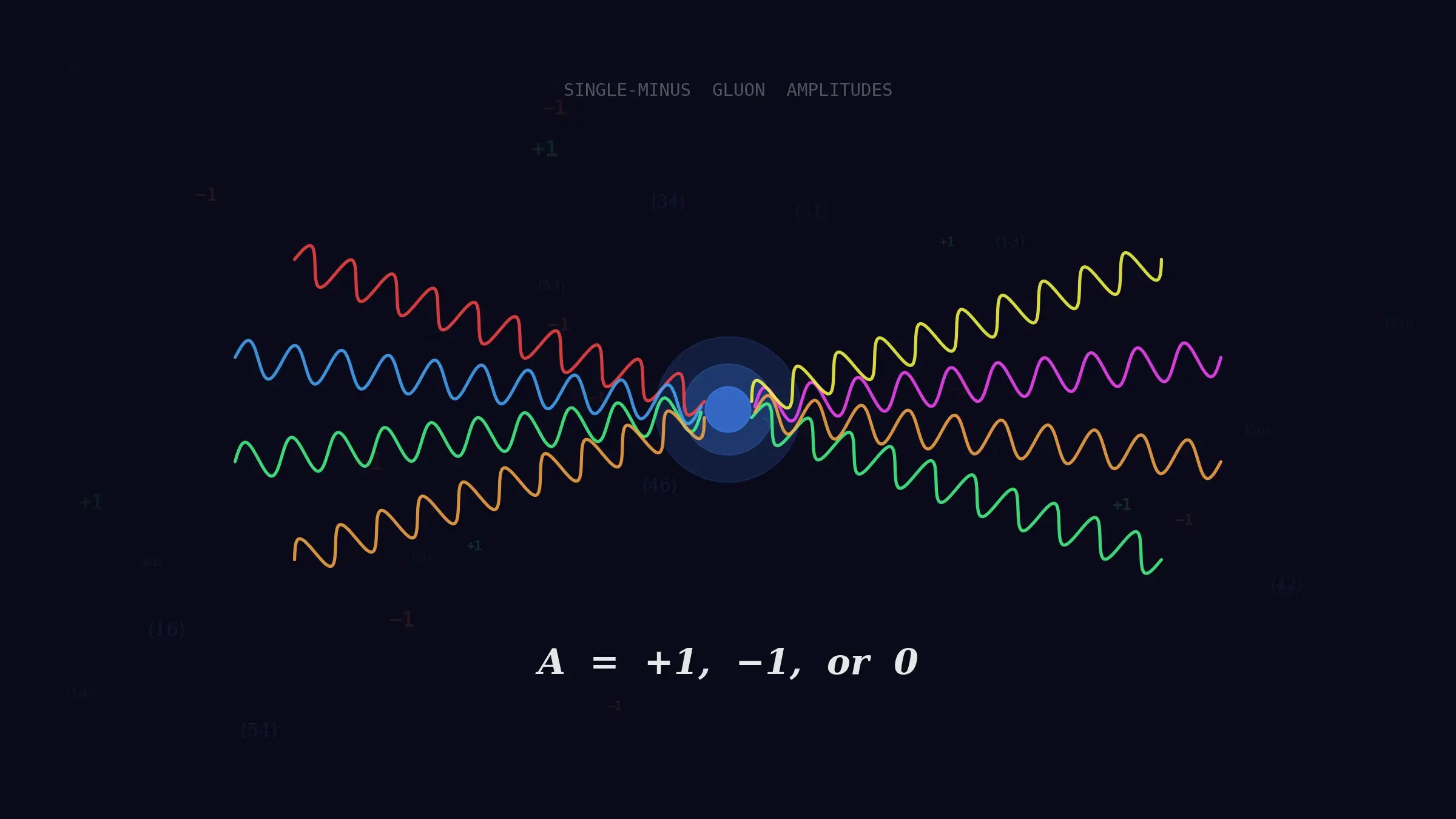
GPT-5.2 Cracked a 40-Year Gluon Mystery
OpenAI's model conjectured a formula for gluon amplitudes assumed zero since 1986. Physicists from Harvard and Cambridge confirmed it was right.


Mantle Earthquakes: First Global Map in 35 Years
Stanford created the first global map of mantle earthquakes: 459 quakes below the crust over 35 years. A discovery reshaping tectonics.