Great Attractor: What Pulls Our Galaxy at 1000 km/s
Authors: Alan Dressler, Andrew Monson

Our galaxy is falling. The whole Milky Way, all four hundred billion stars of it, is in motion at roughly 630 kilometers per second relative to the cosmic microwave background. That’s an enormous number, and we’ve known it since the 1970s from the dipole anisotropy of the CMB itself — one side of the sky is about a thousandth of a percent warmer, the other side a thousandth cooler, and that’s the direct fingerprint of our motion. Where are we going? Toward a patch of sky in the southern constellations, near Centaurus and Hydra. But what’s pulling us there? That question has nagged one of the most respected astronomers of the twentieth century for forty years — and in 2026 he came back to answer it.
Why the Problem Was Supposed to Be Unsolvable
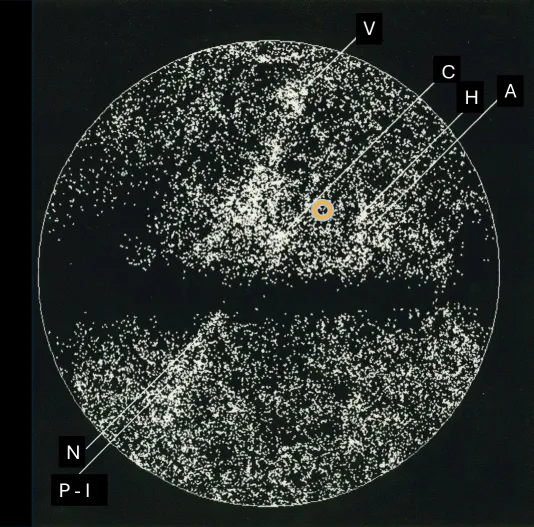
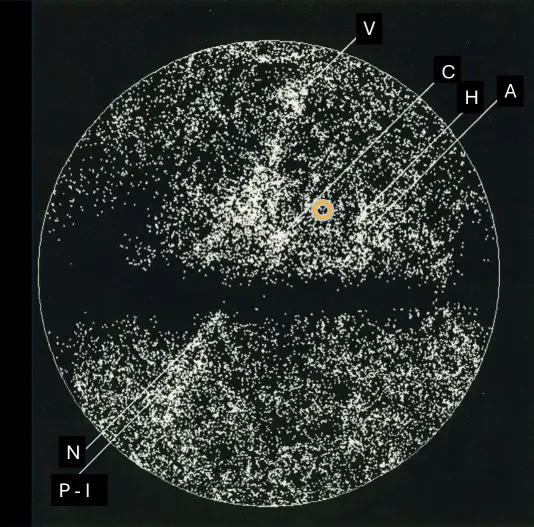
Fig. 1: Galaxy density across one sky hemisphere. The Virgo, Centaurus, Hydra, Pavo-Indus, and Norma clusters are marked. The Great Attractor outshines them all, even behind Milky Way dust. The orange ring shows the direction of the CMB dipole. Source: Dressler & Monson 2026, arXiv
In 1986, seven astronomers — Alan Dressler, Sandy Faber, David Burstein, Roger Davies, Donald Lynden-Bell, Roberto Terlevich, and Gary Wegner — published a paper that changed how we think about the structure of the universe. They became known as the «Seven Samurai.» They measured distances and velocities for about 400 elliptical galaxies and found something strange: they were all falling. Not each one toward its own neighbor, but together, in the same direction, toward the same point on the sky. The direction matched where we ourselves were going — into the southern sky behind Centaurus and Hydra.
The problem was that nothing special was visible there. Nothing, that is, was visible. Between Earth and the presumed source of the pull sits the plane of our own galaxy — the «Zone of Avoidance, ” a dense band of dust and gas in the Milky Way that blocks light from almost everything behind it. The Seven Samurai called the hypothetical mass the Great Attractor, and estimated it roughly: on the order of 5×10¹⁶ solar masses, at a distance of about 65–75 megaparsecs.
Megaparsec (Mpc) — a unit for intergalactic distances. One megaparsec is 3.26 million light-years. For context: the nearest major galaxy, Andromeda, is 0.8 Mpc away, and our Local Group spans about 1 Mpc.
Seventy megaparsecs is, by human scales, unimaginable. By cosmological scales, it’s basically the neighborhood. It should in principle be visible to ordinary telescopes — but in this particular direction, most of it is hidden behind galactic dust.
What Went Wrong in Forty Years
The Seven Samurai set the frame. Over the following decades, others refined, challenged, and redrew it. By the 2010s, new data was coming in from Cosmicflows — a series of massive peculiar-velocity catalogues that used not 400 but tens of thousands of galaxies. And that’s when the trouble started.
Some groups analyzing Cosmicflows-4 (the latest version) began reporting that the bulk flow extends much farther than anyone had thought — not just to 70 Mpc, but to 150, 200, even 300 megaparsecs. If true, bulk flows on such scales are hard to reconcile with the standard ΛCDM cosmological model, which predicts a quieter universe on larger distances. A 2023 paper by Watkins and colleagues even suggested this anomaly as a possible partial resolution of the «Hubble tension» — the stubborn discrepancy between the expansion rate inferred locally and from the CMB.
Meanwhile, other teams painted a different picture. In 2017, Yehuda Hoffman and colleagues published the concept of the Dipole Repeller in Nature Astronomy: a vast underdense region of space that pushes our galaxy rather than pulling it. In that framing, the Great Attractor isn’t the sole cause of our motion. We’re flying not only toward mass but away from emptiness on the opposite side of the sky. The two forces add up to the direction the CMB dipole points in.
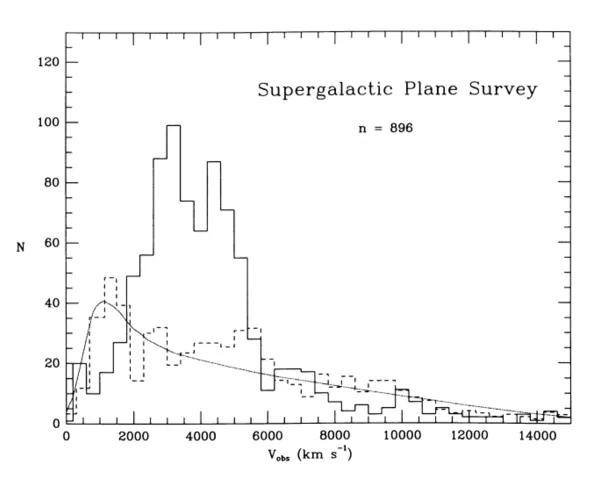
Fig. 2: Galaxy redshift histogram (solid line) in the GA region shows a double peak near V≈4500 km/s — a distant cluster and the foreground galaxies falling toward it. Source: Dressler & Monson 2026, arXiv
By 2025, the situation looked like this: two competing pictures, both camps confident, observational methods different, and no clean way to settle it. Until Dressler came back.
The Instrument That Finally Gave Precision
The new Dressler and Monson paper uses Surface Brightness Fluctuations — SBF. The idea is that in a distant elliptical galaxy individual stars can’t be resolved on the image, but the statistical fluctuations in surface brightness caused by the random distribution of stars per pixel can be measured. The further the galaxy, the smaller the fluctuations (stars average out over more volume per pixel). This dependence can be calibrated, and it yields remarkable distance accuracy — 5 percent per galaxy.
SBF (Surface Brightness Fluctuations) — a method of measuring distances to elliptical galaxies through statistical analysis of surface-brightness variations. Developed in the 1980s, it became especially powerful with modern infrared cameras on large telescopes. Today it’s one of the most precise distance indicators in the 10–150 Mpc range.
To get those measurements, Dressler and Monson used the FourStar camera on the Magellan-Baade telescope at Las Campanas Observatory (Chile) — one of the most capable instruments in the southern hemisphere. They observed in the H-band (near-infrared) a sample of 66 galaxies with radial velocities between 2000 and 5000 km/s — exactly the range where the Great Attractor is expected to live. Each galaxy was imaged at high signal-to-noise to extract the SBF distance with maximum precision.
That matters. Five percent accuracy on 66 galaxies gives an unprecedented map of peculiar velocities in a specific sky region. Earlier studies had enough precision to show that a flow exists. This one has enough precision to say where the flow actually stops.
What the Data Showed
The main result can be compressed into one sentence: the galaxy flow in the Great Attractor region peaks at about 1000 kilometers per second and converges to zero at roughly 70 megaparsecs from the Local Group. And the direction of this flow aligns with the direction of the CMB dipole.
A thousand km/s is a staggering number. For comparison: Earth’s orbital velocity around the Sun is 30 km/s. The Sun’s orbital velocity around the center of the Milky Way is 220 km/s. Galaxies in the Great Attractor region are moving roughly five times faster than that. And it’s all coherent — millions of galaxies moving together in one direction.
But the headline isn’t the «1000.» It’s the «70.» If the flow converges at 70 Mpc, then everything beyond that doesn’t participate in the picture. That means: the CMB dipole is generated locally. Inside about 100 Mpc, not on scales of 300 and up. It’s a direct blow to any picture in which enormous bulk flows extend to hundreds of megaparsecs.
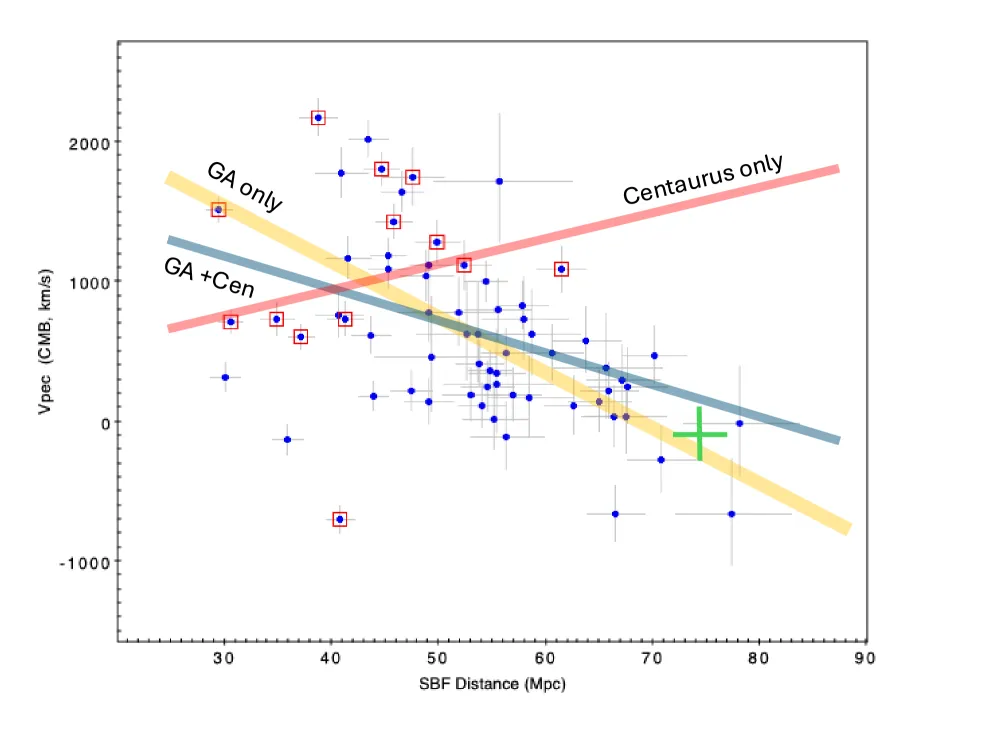
Fig. 3: Peculiar velocities of galaxies in the GA region as a function of distance. The flow peaks around 40 Mpc and converges to zero at 70 Mpc. Source: Dressler & Monson 2026, arXiv
If the authors are right, hypotheses about deep bulk flows that might feed the Hubble tension or hint at deviations from ΛCDM lose their main empirical grounding. Dressler and Monson write plainly that their results are «among the most secure measurements in cosmology, ” and that those results are consistent with what ΛCDM predicts: real structures in the local volume, a statistically quiet universe beyond.
Critical Analysis: What Could Break This Conclusion
The paper appeared on arXiv in April 2026. As of this writing, formal peer review isn’t complete — though the authors are scientists with impeccable reputations and long track records in the field.
The most obvious limitation is the sample size. Sixty-six galaxies is small compared with the thousands in Cosmicflows-4. Dressler’s advantage is precision per measurement, not statistical volume. But a smaller sample covers less sky, and the flow might go to zero at 70 Mpc in the part of the sky they imaged while reappearing elsewhere. Critics can hold that position until a wider SBF campaign settles it.
The second is systematic differences between methods. SBF and the methods used in Cosmicflows-4 (Tully-Fisher, Fundamental Plane) rely on different astrophysical assumptions. If one technique systematically offsets distances compared to the other, results will diverge even with no measurement error. Fully resolving the dispute will take cross-calibration of both methodologies on the same set of galaxies.
The third is possible confirmation bias. Dressler was one of the people who discovered the Great Attractor in 1986. His return, forty years later, with «final confirmation» of his own model can be read as either the triumph of rigorous science or as an example of how a researcher’s priors shape interpretation. That’s not an accusation — it’s a reminder that field-transforming results need independent replication. Someone else has to repeat the observations, preferably with a different instrument and in a different band.
And finally — what about the Dipole Repeller? Hoffman and colleagues already showed that much of our motion can be explained not by one Attractor but by a combination of pulling and pushing regions. The Dressler paper doesn’t directly engage with the repeller, and it isn’t clear how compatible the new data are with it. That’s a topic for the next round.
What This Changes for Cosmology
If Dressler and Monson’s results survive independent scrutiny, this will be an important confirmation of the standard picture: ΛCDM works on every scale we can currently test. The Great Attractor, despite its mythological reputation, is an ordinary gravitating structure — mostly dark matter and galaxy clusters, chiefly the Norma Cluster and its surroundings. Nothing exotic, nothing demanding new physics.
For anyone following the Hubble tension — the discrepancy between local and cosmological measurements of the expansion rate — the news is also significant, but in a different direction. One hope had been that large bulk flows at hundreds of Mpc somehow fed the anomaly. Dressler says: no such flows exist. The tension will have to be resolved somewhere else — perhaps in dark energy physics, perhaps in supernova distance systematics.
But the real story is one of return. Alan Dressler was a young astronomer in 1986, when his group first spotted a strange coherent motion of galaxies. Back then, he couldn’t measure it with the precision the problem demanded. Forty years later, technology reached the point where his own question could be answered. That’s a rare arc in science: a scientist who poses a problem at the start of a career and lives to solve it before the end. Not because the problem turned out to be simple. Because he didn’t let go of it.
Frequently Asked Questions
What is the Great Attractor and where is it pulling us?
The Great Attractor is an enormous mass concentration about 70 megaparsecs away, in the direction of Centaurus and Hydra constellations. The Norma Cluster dominates it. Under its gravitational influence, thousands of neighboring galaxies — including the Milky Way — are moving at about 630 km/s relative to the cosmic microwave background.
Does this mean we’ll collide with the Great Attractor?
No. The distance is too large and cosmic expansion keeps pushing objects apart. At current speeds, crossing 70 Mpc would take more than 100 billion years — longer than the age of the universe. By then the Attractor will no longer be «local» at all, thanks to ongoing expansion.
Why is the «Zone of Avoidance» a problem?
It’s a dense band of Milky Way dust blocking about 20% of the sky. Optical light barely passes through. That’s why the Great Attractor remained invisible for so long — it lies right behind this band. Infrared observations (like the ones Dressler used with FourStar) partially solve the problem, since longer wavelengths scatter less in dust.
What’s the CMB dipole and how does the Great Attractor connect?
The cosmic microwave background is the «echo» of the Big Bang, filling all of space. If we were stationary, it would be perfectly isotropic. But because we’re moving, the radiation appears slightly hotter in the direction of motion and slightly cooler in the opposite direction. That first-order asymmetry (the dipole) tells us where and how fast we’re going. The alignment between the CMB dipole and the direction toward the Great Attractor is strong evidence that the Attractor (plus other local structures) generates our motion.
If Dressler is right, does the Hubble tension go away?
No — the Hubble tension is a separate anomaly. It’s about the discrepancy between local measurements of the expansion rate (from Type Ia supernovae) and the rate inferred from the CMB. Dressler shows only that large-scale bulk flows aren’t a viable explanation. The anomaly itself stays, and its source will have to be found elsewhere in physics.
References
Related
Context
Related Articles

CDG-2: A Galaxy Made of 99% Dark Matter
CDG-2 in the Perseus cluster is 99% dark matter, detected only through four globular clusters — the first galaxy ever found exclusively via its cluster population.