CDG-2: A Galaxy Made of 99% Dark Matter
Authors: David Li

Why This Matters
Imagine a galaxy that is almost impossible to see. Not because it is small or too distant, but because it barely emits any light at all. It has stars — just a handful, equivalent to about six million Suns. But the vast majority of its mass is dark matter: an invisible substance that does not interact with light. It is, in effect, a ghost with gravity.
That is exactly what astronomers at the University of Toronto found in the Perseus galaxy cluster, 300 million light-years away. CDG-2 — Candidate Dark Galaxy 2 — may be the first confirmed member of an entire class of nearly pure dark matter systems. And it was found in a fundamentally new way: not by looking for starlight, but by spotting four globular clusters that gave away their invisible host.
The discovery matters on two levels. First, it demonstrates that the standard method of finding galaxies — looking for light — does not always work. Second, if CDG-2 is truly what it appears to be, it confirms that dark matter can exist in the form of self-contained galactic structures almost completely devoid of baryonic matter — the ordinary atoms that make up everything we can touch.
The Core Idea
Dark matter — a hypothetical form of matter that does not interact with electromagnetic radiation. Its existence is inferred from gravitational effects on visible matter: galaxy rotation curves, gravitational lensing, and the large-scale structure of the universe. Dark matter accounts for roughly 27% of the total energy content of the universe.
David Li and his team took an unconventional approach. Instead of searching for the faint diffuse glow of the galaxy itself, they focused on compact, relatively bright globular clusters — ancient spherical families of tens to hundreds of thousands of stars packed tightly together. These clusters remain visible even across enormous distances.
Globular clusters — gravitationally bound systems of tens of thousands to several million stars, forming a compact sphere. Most are older than 10 billion years. They serve as cosmic beacons: far easier to spot than the diffuse starlight of the galaxy that hosts them.
The key insight relies on a well-established empirical relationship: the number of globular clusters in a galaxy correlates tightly with the total mass of its dark matter halo. This relationship holds across a wide range of galaxy masses, from dwarfs to giants. So if you find four tightly grouped globular clusters with no obvious host galaxy, you can attempt to estimate how massive the structure holding them together must be.
Dark matter halo — an extended, roughly spherical cloud of dark matter that surrounds the visible parts of a galaxy. For the Milky Way, the halo extends hundreds of thousands of light-years beyond the visible disk.
How It Works
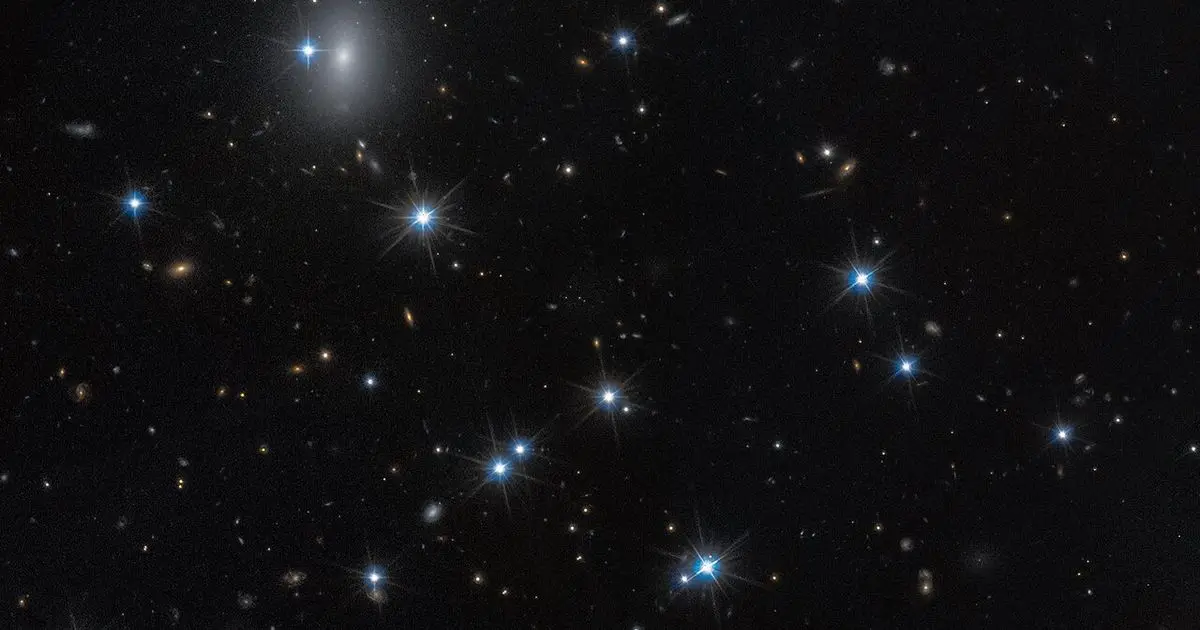
The search began with data from the Euclid space telescope, which is conducting a wide-field survey of the sky. The Perseus cluster — one of the nearest large galaxy clusters to Earth — fell within its field of view. An analysis of the data revealed a suspiciously compact grouping of four point-like sources with no obvious host galaxy.
Galaxy cluster — a gravitationally bound system of hundreds to thousands of galaxies, embedded in a common dark matter halo. The Perseus cluster lies roughly 250-300 million light-years away and contains more than a thousand member galaxies.
Confirming the discovery required three instruments working in concert:
The Hubble Space Telescope provided high-resolution imaging. Its data made it possible to verify that the four point-like sources were genuinely globular clusters and not individual stars or quasars. Hubble also allowed the team to measure the diffuse emission in the region where CDG-2 presumably sits — it turned out to be extraordinarily faint.
The Subaru Telescope contributed ground-based observations for cross-verification.
Euclid provided the wide-field context, showing the object’s position within the Perseus cluster and helping assess the probability of a chance alignment.

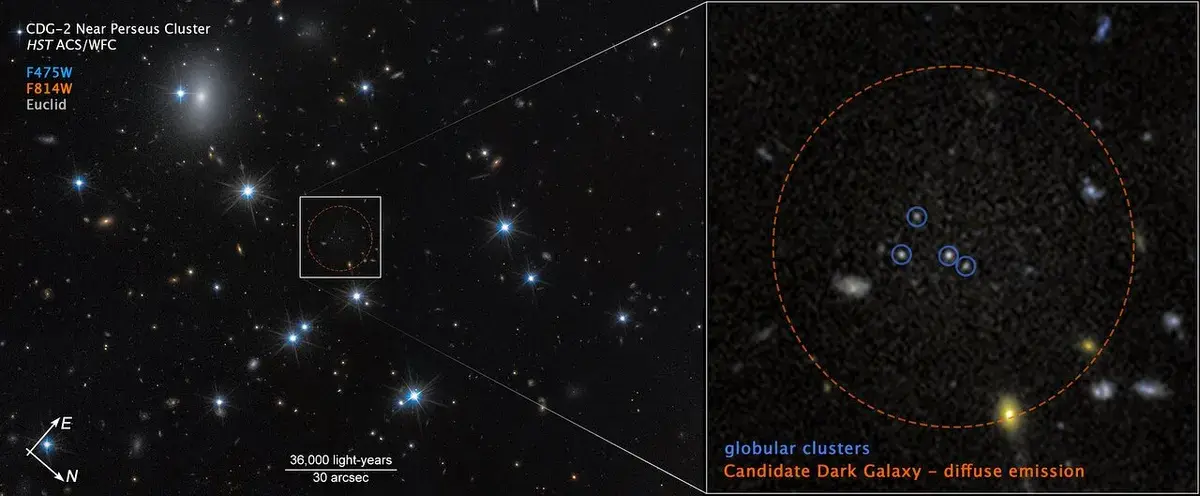
Statistical analysis showed that the probability of four globular clusters appearing this close together by chance, without an underlying structure to hold them, is negligibly small. The authors emphasize that even under the most conservative assumptions — treating the four observed clusters as the galaxy’s entire globular cluster population rather than a subset of a larger system — the estimated dark matter halo mass remains enormous.
The distance was determined indirectly: CDG-2 is spatially coincident with the Perseus cluster, and the team assumed that it is a genuine member of that structure rather than a foreground or background object.
Results
The key numbers the team derived from their analysis:
- Luminosity: equivalent to roughly 6 million Suns. This is extraordinarily low for an object of this scale.
- Dark matter fraction: approximately 99% of the total system mass. For comparison, dark matter makes up roughly 85-90% of the Milky Way’s total mass.
- Four globular clusters account for 16% of all the visible light from CDG-2. The galaxy itself, in the space between those clusters, is nearly invisible.
- Detection method: for the first time in history, a galaxy has been discovered exclusively through the statistics of its globular cluster population, with no reliance on diffuse stellar light.
To put the luminosity in perspective: the Milky Way has a luminosity on the order of 20-25 billion solar luminosities. CDG-2 is more than three thousand times fainter. If our galaxy were a brightly lit city, CDG-2 would be a lone house in a dark field where someone forgot to turn on the lights — but the gravity is still very much there.
The paper was published in The Astrophysical Journal Letters (2025, 986, L18), a peer-reviewed journal of the American Astronomical Society focused on results of immediate significance to the field.
Critical Analysis
The paper has been peer-reviewed and published in The Astrophysical Journal Letters (2025, 986, L18), though several key conclusions rest on indirect methods with notable uncertainties.
What makes the CDG-2 discovery methodologically significant is precisely its departure from the standard playbook. Traditional galaxy surveys look for diffuse stellar emission; Li’s team looked instead for compact globular clusters, which remain visible across vast distances even when the host galaxy itself is nearly invisible. The three-telescope combination — Euclid providing the wide-field trigger, Hubble resolving the individual clusters and constraining the diffuse emission, and Subaru contributing independent ground-based verification — substantially reduces the probability that the signal is an instrumental artifact. Euclid’s role as the primary discovery instrument is also notable: it makes this finding independent of the methods that have driven ultra-diffuse galaxy searches to date, suggesting that future wide-field Euclid data could reveal an entire population of similar objects.
The limitations, however, are serious and stack up quickly. The most fundamental is that CDG-2’s mass is derived entirely indirectly, via the empirical relationship between globular cluster count and dark matter halo mass — a relationship with significant scatter, particularly at the low-mass end where CDG-2 sits. That inference is built on a sample of just four clusters, which is an extraordinarily thin statistical foundation: with so few data points, fluctuations in even one cluster’s photometric classification can shift the halo mass estimate substantially. Compounding this, the redshift of CDG-2 has never been measured directly; membership in the Perseus cluster is assumed from spatial coincidence alone. If the object turns out to be at a different distance — a foreground or background structure — every mass estimate changes accordingly. Nor does the absence of detected neutral hydrogen settle the matter: the lack of HI is consistent with dark matter dominance, but equally consistent with gas having been stripped by tidal forces or ram pressure from the hot intracluster medium of Perseus. CDG-2 could also be a tidal remnant of a disrupted galaxy rather than a self-contained dark matter structure.
The cautionary precedent here is Dragonfly 44. In 2016, that galaxy in the Coma cluster was presented as an object with an anomalously large dark matter fraction, generating enormous excitement — only for subsequent observations to reveal that the initial mass estimates had been significantly overestimated. CDG-2 is in a similar position: a fascinating candidate in need of independent spectroscopic confirmation before its exceptional nature can be considered established rather than inferred. How typical CDG-2 is — whether it belongs to a large hidden population or is an unusual outlier — is a question that only systematic follow-up across many galaxy clusters can begin to answer.
What Comes Next
The most critical next step is a direct spectroscopic measurement of CDG-2’s redshift. This would pin down the object’s distance precisely and either confirm or substantially revise all current mass estimates. Given the object’s low luminosity, this will require one of the world’s largest telescopes: likely the Very Large Telescope in Chile or one of the 10-meter Keck Observatory telescopes in Hawaii.
Parallel deep radio observations searching for the HI emission line would also be highly informative. A galaxy with a purely dark matter halo and one that has had its gas stripped by the cluster environment are physically very different objects, even if they look similar in optical images.
If CDG-2 is confirmed as a genuine dark galaxy, it creates a blueprint for searching for analogues in other galaxy clusters. Euclid is surveying the entire sky — and in principle it should reveal many more such groupings of globular clusters without obvious hosts. This could open up a census of dark matter structures across the observable universe.
Finally, if a large population of such objects were found, it would require a reassessment of galaxy formation models. The standard cosmological model predicts a large number of small dark matter halos in which star formation is suppressed or never began for various physical reasons. CDG-2 may be the first confirmed representative of exactly this predicted but never-yet-observed population. Or it may not. For now, we have four globular clusters and a great many questions.
References
Related Articles


ENIGMA: Reading Minds in 15 Min via EEG
ENIGMA reconstructs images from EEG signals after 15 min of calibration, using under 1% of previous methods' parameters.


Mantle Earthquakes: First Global Map in 35 Years
Stanford created the first global map of mantle earthquakes: 459 quakes below the crust over 35 years. A discovery reshaping tectonics.


NVIDIA Cosmos 2026: Open AI That Teaches Robots Physics
Open-source platform from NVIDIA generates physics-accurate worlds so robots learn without real crashes. Free models, 12M training hours.