GPT-5.2 Cracked a 40-Year Gluon Mystery
Authors: Alfredo Guevara, Alexandru Lupsasca, David Skinner, Andrew Strominger, Kevin Weil

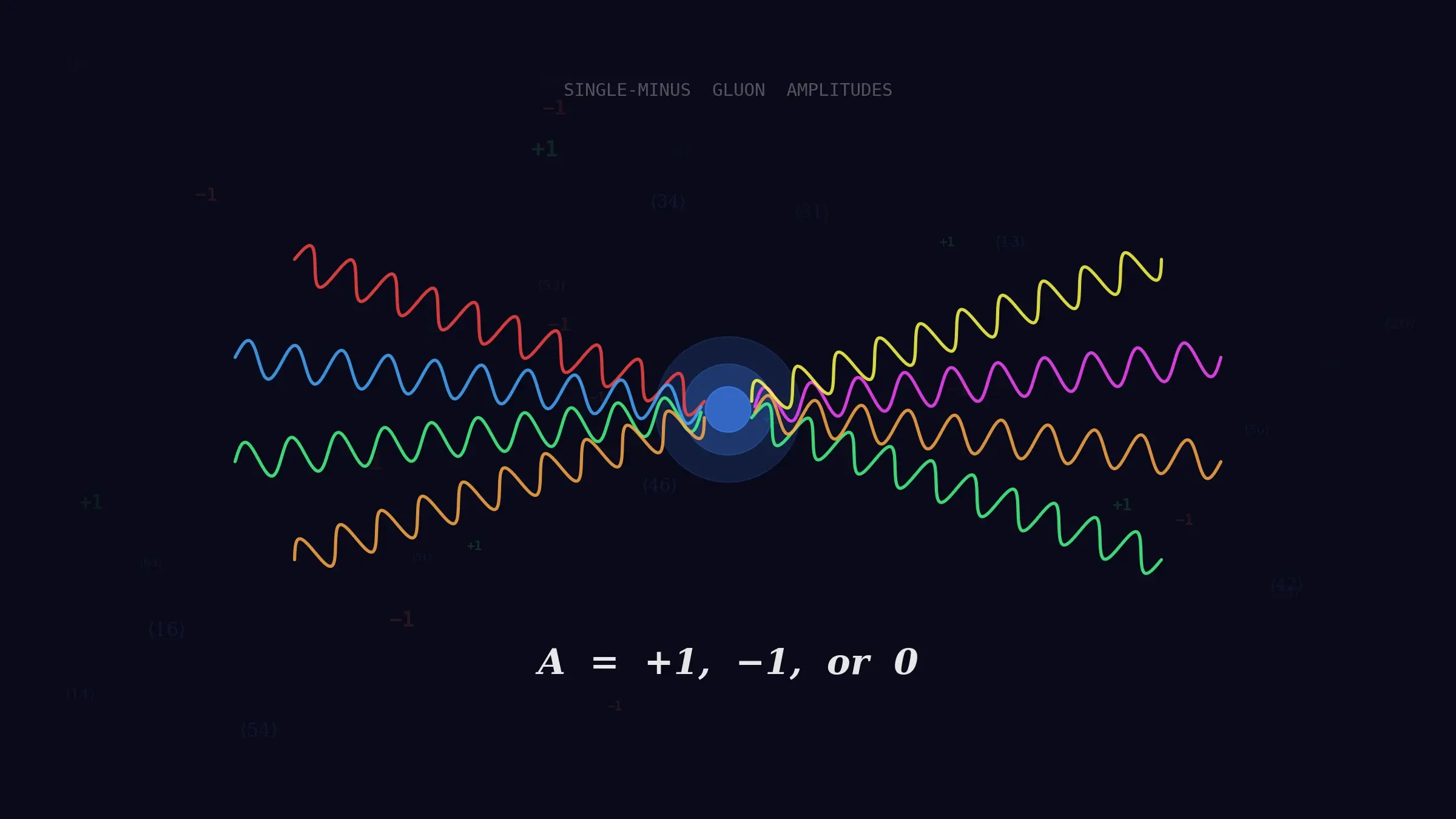
For forty years, one equation in particle physics had a simple answer: zero. Textbooks printed it. Graduate students memorized it. Professors waved it away as settled science. In February 2026, a language model named GPT-5.2 Pro looked at the same equation and said: actually, no. A team from Princeton’s Institute for Advanced Study, OpenAI, Cambridge, and Harvard verified the result. The textbooks were wrong.
The Assumption Nobody Questioned for Forty Years
Gluons carry the strong nuclear force — the force that holds quarks together inside protons and neutrons. The name is literal: they glue matter together at the subatomic scale. When gluons collide, they scatter, and the probability of each possible outcome lives inside a mathematical object called a scattering amplitude.
Scattering amplitude — a mathematical expression encoding the probability of a specific outcome when particles collide. More accurate amplitudes mean more precise predictions at particle colliders like the LHC.
In 1986, Stephen Parke and Tomasz Taylor found one of the most elegant formulas in all of theoretical physics. It described scattering amplitudes for gluons where exactly two carry negative helicity — a spin direction relative to their motion. The formula fit on a napkin. It won awards. It launched an entire subfield.
Helicity — the projection of a particle’s spin onto its direction of motion. For massless particles like gluons, helicity is either +1 or −1. Picture the gluon spinning clockwise or counterclockwise as it flies.
But a simpler case lurked in the background. What happens when only one gluon has negative helicity and all others are positive? These «single-minus» amplitudes were declared zero. The argument: pick the right mathematical reference frame, and every term in the expression cancels out. Clean. Elegant. Nobody published a formal proof because the logic seemed airtight.
It became folklore. A fact everyone knew. A fact nobody checked.
A Loophole Hidden in Plain Sight
The folklore argument contained an invisible premise: certain mathematical quantities called spinor brackets can always be made nonzero by a clever choice of reference spinor. In ordinary Minkowski spacetime — three spatial dimensions, one time dimension — this is true.
Spinor bracket — a compact mathematical notation (written ⟨ij⟩) that encodes geometric relationships between the momenta and spins of colliding particles. When it equals zero, two particles are moving in the same direction.
Theoretical physicists, however, do not always work in ordinary spacetime. They routinely extend their calculations to complexified momenta, where momentum components take complex values. They study scattering in Klein space — a four-dimensional arena with two time dimensions instead of one. These extensions are not idle curiosities. The BCFW recursion relations, the amplituhedron, twistor string theory — cornerstones of modern amplitude research — all live in these extended settings.
Klein space — a mathematical spacetime with signature (2,2): two time dimensions and two spatial dimensions. While nobody claims we physically inhabit it, formulas derived there often carry over to real physics. It is a standard tool, not a speculation.
In Klein space, there exists a special kinematic configuration — «half-collinear» — where all spinor brackets ⟨ij⟩ vanish simultaneously. The reference-spinor trick fails completely. The cancellation that was supposed to give zero never happens.
Imagine declaring a road perfectly smooth because you drove it every morning in sunlight. One night, under rain, you hit a pothole that was always there. The half-collinear regime is that stretch of road at night.
The Machine That Guessed the Formula
The author list of the February 2026 paper reads like a collision between two worlds. Alfredo Guevara from the Institute for Advanced Study in Princeton. David Skinner from Cambridge. Andrew Strominger from Harvard — a physicist whose work on black holes and celestial holography has reshaped the field. And from OpenAI: Alexandru Lupsasca and Kevin Weil. The paper was published «on behalf of OpenAI.»
Midway through the text, a sentence stops the reader cold: «The key formula (39) for the amplitude in this region was first conjectured by GPT-5.2 Pro and then proved by a new internal OpenAI model.»
The sequence matters. GPT-5.2 Pro did not prove anything. It guessed. It proposed a specific closed-form expression for the single-minus amplitude in the half-collinear region. A separate, newer model at OpenAI then constructed a mathematical proof. The human physicists verified every step through independent methods: Berends-Giele recursion, Weinberg’s soft theorem, Kleiss-Kuijf relations, cyclicity checks, and explicit computation up to six gluons. Every test passed.
Berends-Giele recursion — a method that builds amplitudes for n particles from amplitudes with fewer particles, step by step. If a conjectured formula satisfies this recursion, it is almost certainly correct.
The paper does not reveal how GPT-5.2 was prompted, how many attempts were needed, or what chain of reasoning the model followed. This opacity will draw criticism. But the mathematics is indifferent to how it was discovered — and the mathematics checks out.
A Formula Made of Signs
Here is what makes the result so strange. Scattering amplitudes are typically rational functions of kinematic variables — fractions with messy numerators and denominators that grow rapidly with the number of particles. The single-minus amplitudes in the half-collinear region are nothing like that.
They take exactly three values: +1, −1, or 0.
The general formula is a product of sign functions — each just +1 or −1, depending on the sign of a spinor bracket. For three gluons: A₃ = sg₁₂, a single sign. For four gluons: A₄ = ½(sg₂₃ · sg₄₁ + sg₁₂ · sg₃₄). Each additional gluon adds one more factor to the product. The amplitude is piecewise constant, jumping between +1 and −1 across «walls» — hypersurfaces where a sign function flips.
This discrete, almost topological character is unlike anything seen before in gluon scattering. Amplitudes are supposed to be smooth functions. These are not. Whether this hints at deeper mathematical structure — perhaps connections to the amplituhedron or celestial holography — remains an open question the authors flag explicitly.
A Crack in the Division of Labor
The immediate physics impact is circumscribed. The half-collinear region is not probed by the LHC. Experimentalists at CERN will not rewrite analysis code because of this paper. But in theoretical physics, surprises in unusual kinematic corners have a track record of reshaping the entire landscape. The BCFW recursion came from a clever analytic continuation. The amplituhedron emerged from studying limits nobody expected to matter.
The deeper shift is methodological. This is among the first documented cases where an AI system conjectured a nontrivial result in fundamental physics that human experts had overlooked — not by computing faster, but by noticing a blind spot in the community’s collective assumptions. GPT-5.2 did not crunch integrals more efficiently than Mathematica. It saw something the field had stopped looking for.
A three-stage workflow crystallized in this paper: AI conjectures, AI proves, humans verify. If the pattern holds, the physicist’s role evolves — from the person who finds the answer to the one who picks the problem and audits the solution.
The Space Between Conjecture and Proof
Debate about what it means for a language model to «do» physics is inevitable. GPT-5.2 did not derive the formula from first principles. It synthesized patterns across its training corpus — which includes decades of published physics — and produced a guess that turned out to be correct. Whether that constitutes understanding or sophisticated interpolation is a question for philosophers of science, not for arXiv referees.
This paper is a preprint posted to arXiv in February 2026 and has not undergone formal peer review.
The practical criticism carries more weight. The paper withholds prompting strategies, failure rates, and the architecture of the model that proved the conjecture. Other research groups can verify the result but cannot replicate the process. For a field built on reproducibility, this is a genuine tension — one that OpenAI’s publishing norms have created before.
Peter Woit, a mathematician at Columbia University and vocal critic of AI-generated physics, has warned of «theoretical physics slop»: output that looks rigorous but lacks genuine insight. In the general case, the concern is valid. But here it collides with a stubborn fact — the formula was proven through standard mathematical methods and survived every consistency test thrown at it. You can question how the conjecture was born. You cannot question that it is correct.
A subtler objection targets the result’s physical significance. The amplitudes are nonzero only in complexified or Klein-space momenta — not in the physical Minkowski signature we observe. Some theorists question whether a «nonzero result in an unphysical regime» really overturns a forty-year consensus. The authors counter that complexified kinematics are foundational to modern amplitude methods: a formula assumed universal but failing in one regime is simply wrong, regardless of whether that regime is directly measurable.
Frequently Asked Questions
Is GPT-5.2 replacing physicists?
Not yet, and likely not soon. The model guessed a formula — it did not choose the problem, design the verification, or interpret the physical implications. The five authors selected the research direction, judged the output, and confirmed it independently. AI here is a powerful collaborator, not an autonomous scientist.
What are gluon scattering amplitudes and why do they matter?
Scattering amplitudes predict what happens when subatomic particles collide — the mathematical backbone of everything physicists measure at colliders. They test the Standard Model, hunt for new particles, and constrain theories of quantum gravity. A forty-year-old assumption turning out to be wrong means the foundation had a crack nobody noticed.
Will this affect experiments at the LHC?
Not directly. The half-collinear regime is not accessed by current collider configurations. However, the result changes our theoretical map of QCD amplitudes, which could influence future computational methods and approximations used in collider physics.
How did GPT-5.2 «guess» the formula?
The paper does not disclose prompting methodology. The model likely identified structural patterns across its training data — published physics papers, textbooks, and preprints. Whether this counts as understanding or as high-dimensional pattern matching remains philosophically open, but the mathematical correctness of the output is established.
Is Klein space real?
Klein space (signature 2,2) is not a physical spacetime we inhabit. It is a standard mathematical tool in theoretical physics — a workspace where calculations often become simpler and results can be analytically continued back to physical Minkowski spacetime. The discovery that amplitudes are nonzero in Klein space tells us something real about the mathematical structure of quantum chromodynamics.
References
Related
- Direct Proof of the Tree-Level Scattering Amplitude Recursion Relation — Britto et al. (2005)
- Perturbative Gauge Theory as a String Theory in Twistor Space — Witten (2004)
- Scattering Amplitudes and the Positive Grassmannian — Arkani-Hamed et al.
- w₁₊∞ Algebra and Celestial Holography — Strominger (2021)
Related Articles

Humanity's Last Exam: The Test AI Keeps Failing
2,500 questions no AI can Google. GPT-4o scored 2.7%, humans hit 90%. Inside the hardest AI benchmark and its 30% error rate.

NbRe: First Triplet Superconductor at 7 K
Physicists found triplet Cooper pairs in niobium-rhenium at 7 K — opening a path to fault-tolerant topological quantum computers.

AI Finds 25 Rare-Earth-Free Magnets in 67,000
AI-curated database of 67,000 magnetic materials reveals 25 high-temperature alternatives to rare-earth magnets for EVs.