Accelerator Destroys Nuclear Waste: 300 Years, Not 100,000
Authors: Rongli Geng, Grigor Tukharyan, William Reed Kendrick, Areg Danagoulian, Benoit Forget

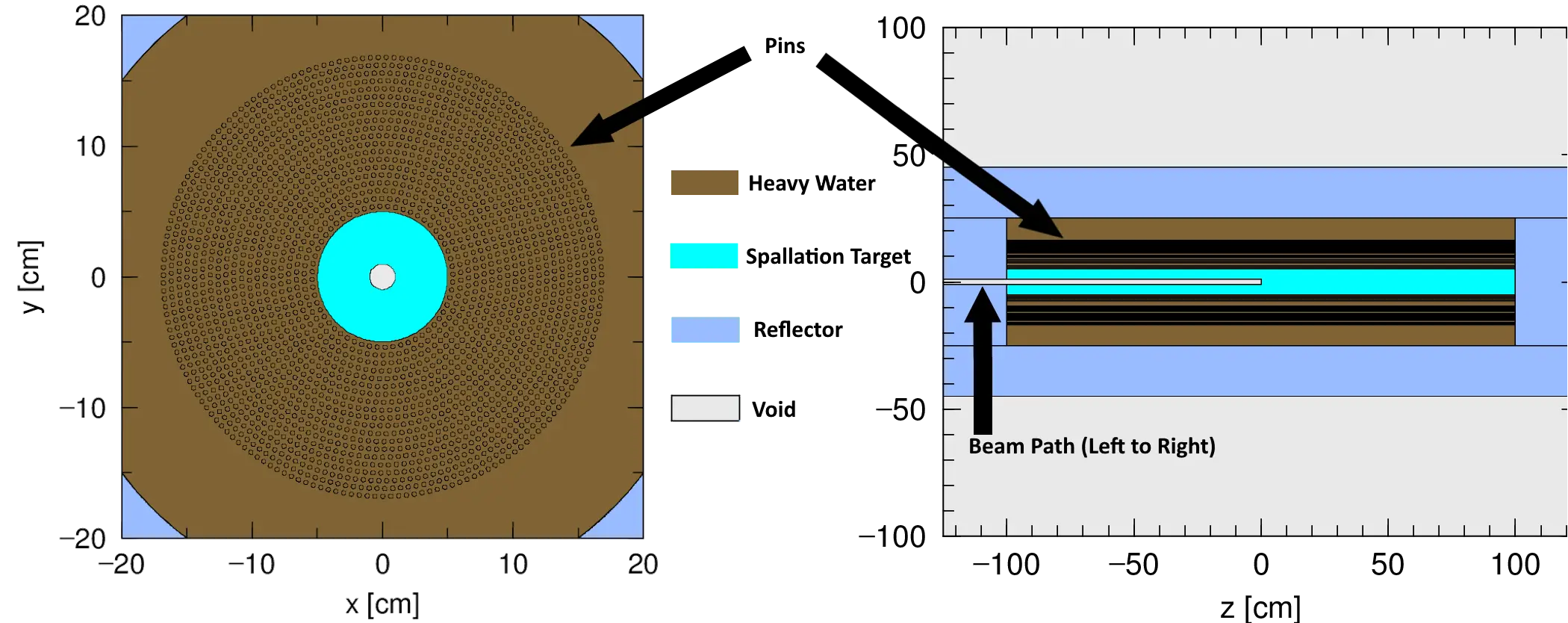
The Number That Changes Everything
One hundred thousand years. That is how long the most hazardous components of spent nuclear fuel remain dangerous — a timescale so vast it dwarfs all of recorded human civilization. Now a team at the U.S. Department of Energy’s Thomas Jefferson National Accelerator Facility claims they can shrink that number to just 300 years — a 99,7% reduction — while simultaneously generating carbon-free electricity from the very waste they destroy.
Why Nuclear Waste Is Such a Headache
Nuclear power produces roughly 10% of the world’s electricity with near-zero carbon emissions. Yet every reactor leaves behind spent fuel containing a cocktail of intensely radioactive isotopes. The short-lived ones decay within decades, but a handful of long-lived fission products (LLFPs) and minor actinides persist for geological timescales:
| Isotope | Half-life | Problem |
|---|---|---|
| Tc-99 | 211,000 years | Mobile in groundwater |
| I-129 | 15.7 million years | Bioaccumulates in thyroid |
| Cs-135 | 2.3 million years | Chemically reactive |
| Zr-93 | 1.5 million years | Structural waste |
| Se-79 | 327,000 years | Volatile compound formation |
| Sn-126 | 230,000 years | High gamma emission |
Humanity’s current best plan? Bury it all deep underground in geological repositories like Finland’s Onkalo or the proposed Yucca Mountain in the U.S., and hope the rock holds for hundreds of millennia. Countries have spent billions on this approach, yet not a single permanent repository is operational for high-level waste anywhere on Earth.
Transmutation — the conversion of one chemical element into another by changing the number of protons or neutrons in the nucleus. In the context of nuclear waste, it means turning long-lived radioactive isotopes into short-lived or stable ones using neutron bombardment.
Enter the Accelerator-Driven System
The concept behind ADS is elegant in its audacity: instead of passively waiting for dangerous isotopes to decay, actively destroy them by bombarding them with neutrons.
Here is how it works, step by step:
- Accelerate — A powerful linear accelerator fires a beam of protons at energies of hundreds of MeV.
- Spallate — The proton beam strikes a heavy metal target (liquid mercury, lead, or depleted uranium). The impact «chips off» dozens of neutrons from each target nucleus — a process called spallation.
- Transmute — This flood of fast neutrons slams into the surrounding blanket of nuclear waste, breaking apart long-lived actinides and fission products into shorter-lived or stable isotopes.
- Harvest — The fission and transmutation reactions release enormous heat, which drives a conventional steam turbine to generate electricity.
The critical safety feature: the reactor core is subcritical — it cannot sustain a chain reaction on its own. Cut the accelerator beam, and the reaction stops within milliseconds. No Chernobyl scenario is physically possible.
The NEWTON Program: From Lab to Grid
In February 2026, Jefferson Lab announced two projects funded by the DOE’s NEWTON (Nuclear Energy Waste Transmutation Optimized Now) program, backed by $8.17 million in grants. The goal is ambitious: make ADS technology practical enough to recycle the entire U.S. commercial nuclear fuel stockpile within 30 years.
The team, led by principal investigator Rongli Geng, is tackling two key engineering bottlenecks:
Niobium-Tin Superconducting Cavities
Traditional superconducting accelerator cavities require liquid helium cooling to ~2 K (−271 °C) — enormously expensive. Jefferson Lab is developing Nb₃Sn (niobium-tin) coated cavities that operate at higher temperatures (~4.2 K), allowing use of cheaper commercial cryocoolers instead of massive custom cryogenic plants.
High-Power Magnetrons
The proton beam needs about 10 megawatts of RF power. The team is adapting magnetrons — yes, the same technology inside your microwave oven — to deliver this power at precisely 805 MHz. In partnership with Stellant Systems, they are building prototypes that can be ganged together to reach the required power levels with maximum efficiency.
Industry partners RadiaBeam and General Atomics are involved from the start, ensuring the technology moves quickly from laboratory to manufacturing.
What the Science Actually Shows
A recent study from MIT (Tukharyan et al., October 2025) provides the most detailed computational analysis to date of spallation-driven transmutation for six key long-lived fission products.

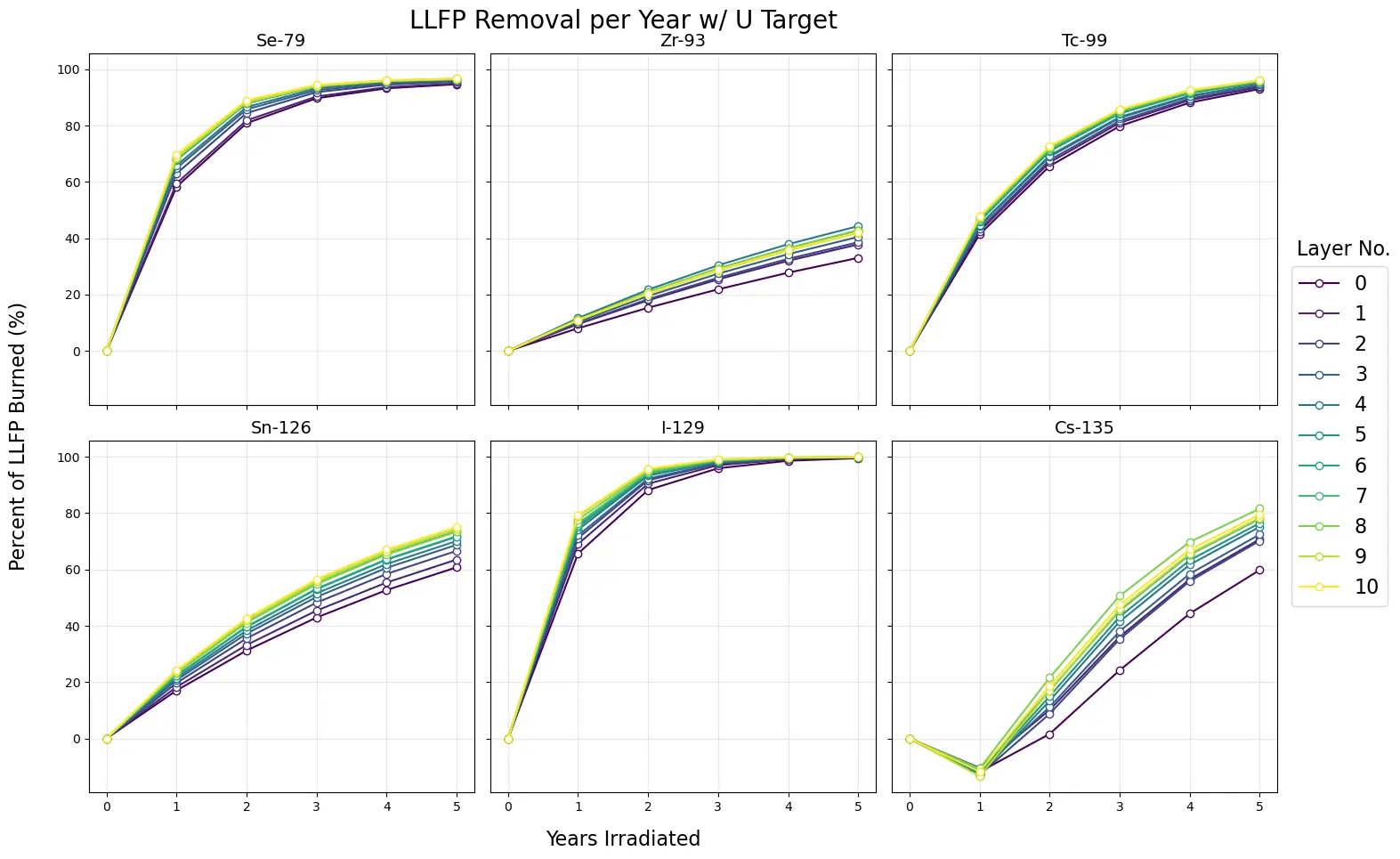
Key findings:
- Technetium-99: >95% destroyed in 5 years — the most cost-effective candidate
- Iodine-129: Nearly 100% transmuted — excellent result
- Selenium-79: ~95% destroyed — highly effective
- Tin-126: ~75% reduction — partial but significant
- Cesium-135: ~60-80% — limited by competing reactions with lighter isotopes
- Zirconium-93: Only ~40% — largely «neutron-transparent, ” making it the hardest to process

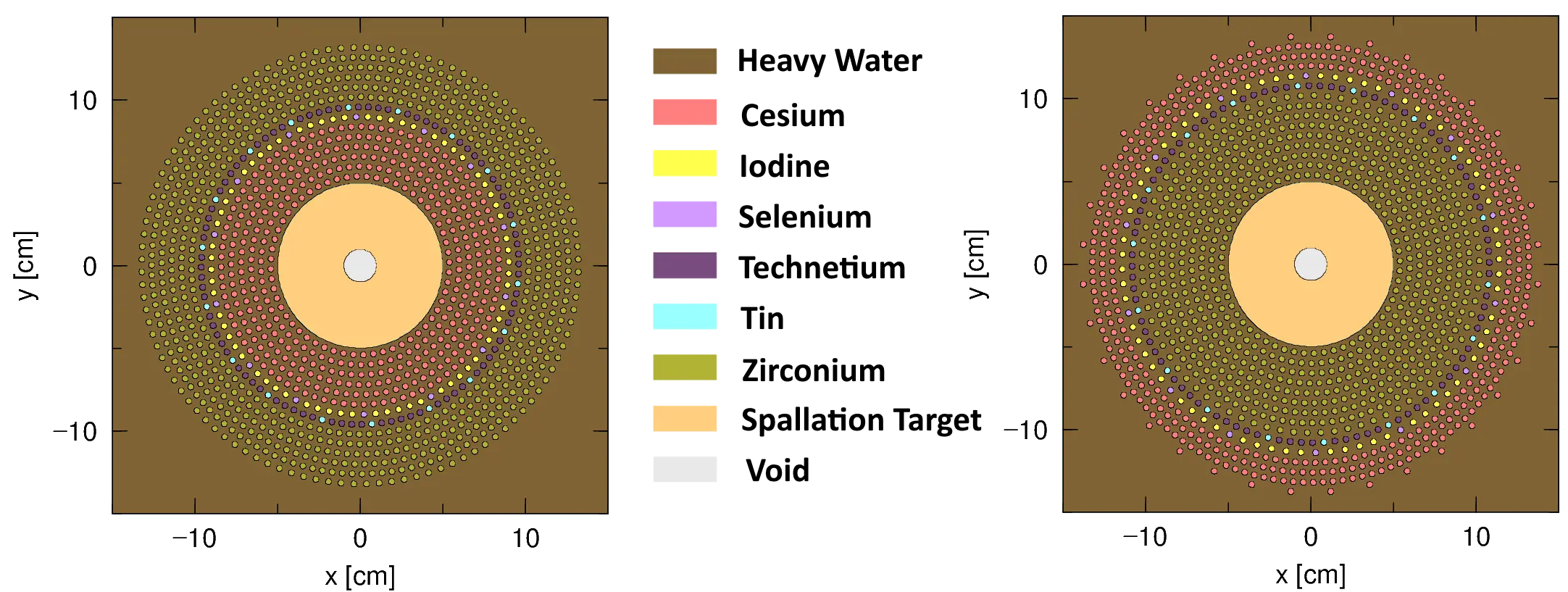
The choice of spallation target also matters significantly:
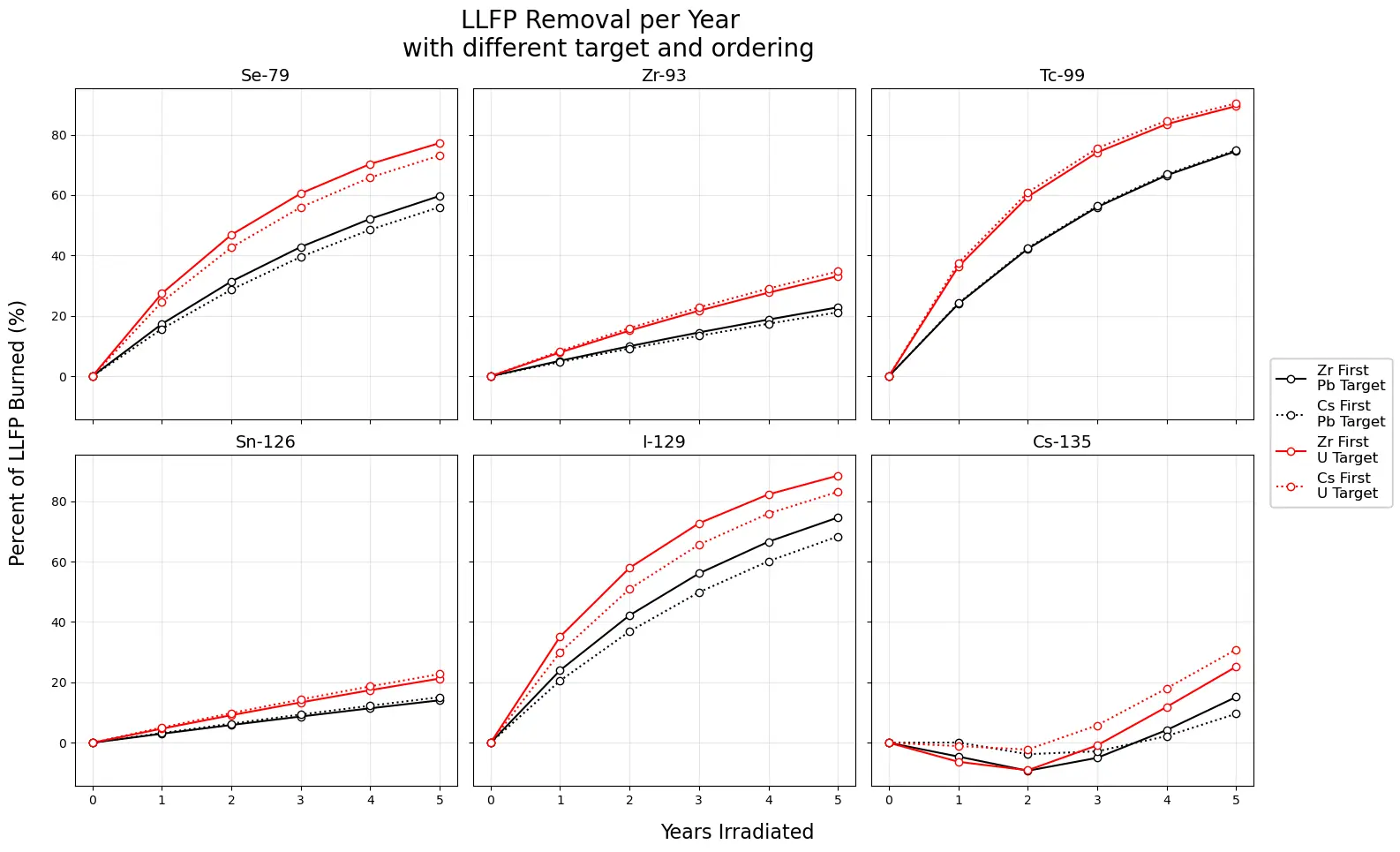
Depleted uranium targets produce roughly 50% more neutrons than lead, boosting transmutation rates — but at the cost of generating their own fission products. The optimal choice depends on the specific waste inventory being processed.
A Critical Look
Strengths
- Inherent safety: Subcritical design eliminates runaway chain reaction risk
- Dual purpose: Destroys waste AND generates electricity — not one or the other
- Proven physics: Spallation and transmutation are well-understood; this is an engineering challenge, not a fundamental science question
- Political potential: Could defuse the most powerful argument against nuclear energy expansion
Limitations
- No working prototype yet: ADS has been discussed for 40+ years; the MYRRHA demonstrator in Belgium is still under construction
- Cost uncertainty: The $8.17M NEWTON grant funds R&D, not a reactor. A full-scale ADS facility would cost billions
- Incomplete solution: Zirconium-93 and cesium-135 resist efficient transmutation — you still need some geological storage
- Accelerator reliability: A commercial ADS needs >95% beam uptime; no proton accelerator has demonstrated this at the required power levels
- The French already had this: Superphénix, a 1200 MW fast breeder reactor, could burn actinides without any accelerator. It was shut down in 1997 for political reasons, not technical ones
Open Questions
- Can Nb₃Sn cavities achieve the beam current and reliability needed for continuous industrial operation?
- How does the cost of ADS compare to simply building more geological repositories?
- Could next-generation fast reactors (like Russia’s BN-800 or China’s CFR-600) achieve similar transmutation goals more cheaply?
What Happens Next
The NEWTON program targets a 30-year timeline to process America’s ~90,000 metric tons of commercial spent fuel. But the immediate milestones are more modest:
- 2026–2028: Demonstrate Nb₃Sn cavity performance and high-power magnetron prototypes
- Late 2020s: Full-scale accelerator component testing
- 2030s: Design validation for a pilot ADS facility
- 2035+: Potential construction of a demonstration plant
Meanwhile, Europe’s MYRRHA project in Belgium aims to be the world’s first operational ADS demonstrator, and China’s CiADS program is advancing steadily with its own lead-bismuth cooled subcritical reactor design.
The technology race is real. The question isn’t whether accelerator-driven transmutation works — it does. The question is whether humanity will invest enough to make it practical before we’ve buried the problem underground and stopped thinking about it.
FAQ
Can ADS completely eliminate the need for geological waste repositories? No. Even with transmutation, some waste products (particularly zirconium-93 and short-lived fission products) still require storage. However, ADS could reduce the required repository volume by 100× and the storage timeframe from 100,000 years to a few centuries.
Is this the same as a nuclear reactor? Not quite. A conventional reactor sustains its own chain reaction (it’s «critical»). An ADS is deliberately subcritical — it needs the external accelerator beam to maintain the neutron flux. Turn off the beam, and the reactions stop almost instantly, making it inherently safer.
Why not just use fast breeder reactors instead? Fast reactors can transmute some actinides, but they struggle with the most problematic long-lived fission products. ADS provides a much higher neutron flux through spallation, enabling transmutation of isotopes that fast reactors cannot efficiently process. In practice, the optimal solution likely involves both technologies working together.
How much electricity could an ADS plant generate? A full-scale ADS facility could produce several hundred megawatts of thermal energy. After subtracting the power consumed by the accelerator itself (~10 MW), a net electrical output of 100–300 MW is feasible — comparable to a small conventional power plant.
When will the first ADS power plant be operational? The most optimistic estimates point to the mid-2030s for a demonstration facility. Commercial deployment, if the technology proves cost-effective, would likely follow in the 2040s. Europe’s MYRRHA project and China’s CiADS are currently the closest to operational status.
References
Related
Related Articles

China Builds the First Reactor That Eats Nuclear Waste
The world's first megawatt-scale ADS reactor launches in Huizhou, 2027 — designed to shrink nuclear waste danger from 100,000 years to under 300.


AI Finds 25 Rare-Earth-Free Magnets in 67,000
AI-curated database of 67,000 magnetic materials reveals 25 high-temperature alternatives to rare-earth magnets for EVs.

CO₂ to Fuel: Tungsten Photocatalyst Breakthrough
A tungsten-based photocatalyst converts CO₂ and water into fuel using only sunlight — mimicking photosynthesis at room temperature.